Open Source Security Management Tools
Find, prioritize and manage security risks across open source dependencies, third-party packages and software components before they reach production.
Build a continuous software supply chain security program with dependency scanning, software composition analysis, SBOM management, license compliance and automated remediation.
What Is Open Source Security Management?
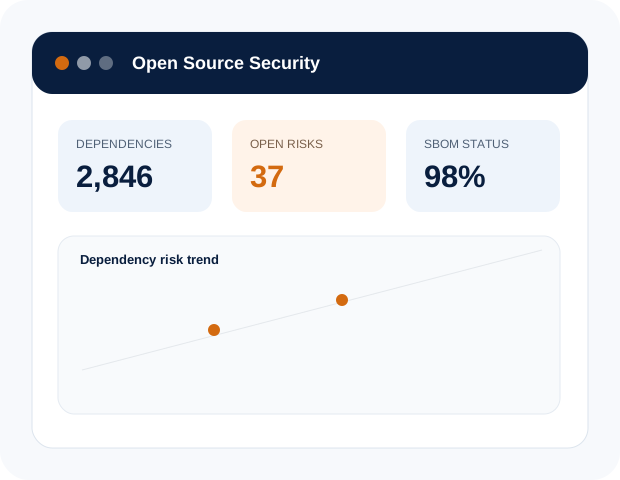
Open source security management is the process of discovering, assessing, governing and continuously monitoring open source and third-party software components used in applications. It typically combines software composition analysis, dependency vulnerability scanning, SBOM management, license compliance, policy enforcement and remediation workflows to reduce software supply chain risk.
Why Open Source Security Management Matters
Modern applications rely on direct and transitive dependencies. Security teams need visibility into what is used, where it is used and what risk changes over time.
Discover Open Source Dependencies
Identify direct and transitive libraries, packages, frameworks and components across applications and development environments.
Find Dependency Vulnerabilities
Detect known vulnerabilities and security weaknesses in open source components and prioritize issues that require attention.
Build and Manage SBOMs
Create software component inventories that improve visibility for vulnerability management, product security and supply chain risk.
Control Open Source Licenses
Identify license obligations and policy violations so legal, engineering and security teams can review open source usage consistently.
Secure the Software Supply Chain
Monitor dependencies, package risk and software component changes as applications move through CI/CD pipelines.
Accelerate Remediation
Connect findings to developer workflows and remediation processes to reduce manual investigation and shorten time to fix.
What Open Source Security Tools Should Monitor
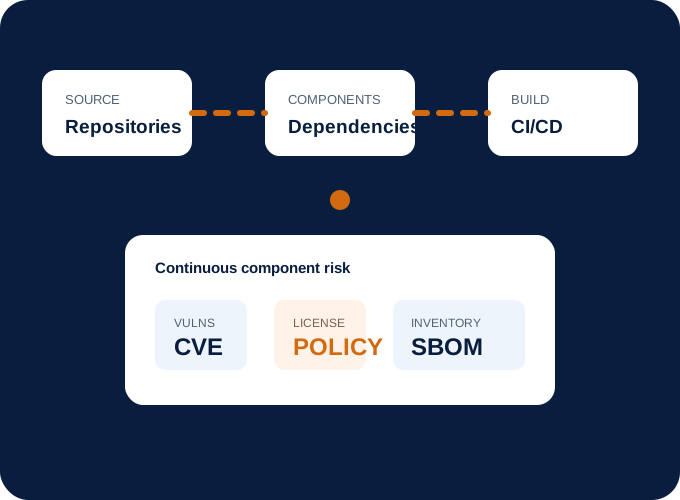
Effective open source security covers more than a list of CVEs. Security teams need component context, dependency relationships, exposure, licensing and remediation options.
- Direct dependencies: packages intentionally added to an application.
- Transitive dependencies: components introduced through other packages.
- Known vulnerabilities: CVEs and security advisories associated with components.
- Malicious or risky packages: indicators that may increase software supply chain exposure.
- License obligations: licenses, policy rules and compliance requirements.
- SBOM and component inventory: a current view of software composition across versions and applications.
Open Source Security Management Capabilities
Use a layered approach to manage application dependencies from development through production.
Software Composition Analysis (SCA)
Analyze application dependencies to identify vulnerable components, outdated packages, license risks and software composition changes.
Open Source Dependency Scanning
Scan package manifests, lock files, binaries and supported application ecosystems to discover dependency risk.
Software Bill of Materials (SBOM)
Generate, import, maintain and analyze component inventories to support vulnerability response and software supply chain transparency.
License Compliance
Map component licenses to organizational policies and identify packages that require legal or engineering review.
Reachability and Risk Prioritization
Use application context and dependency relationships to help teams focus remediation on issues that matter to their environment.
Automated Dependency Remediation
Support upgrade recommendations, pull requests, ticketing and developer workflows where the selected platform provides these capabilities.
Policy and Governance
Define security, licensing and component policies that can be applied consistently across teams, applications and pipelines.
Continuous Monitoring
Track component changes and newly disclosed risks so teams can reassess software exposure after release.
SCA vs SAST vs DAST vs SBOM Management
These practices solve different parts of application and software supply chain security and are often used together.
| Security practice | Primary focus | Typical output |
|---|---|---|
| Software Composition Analysis | Open source and third-party components | Dependency vulnerabilities, license findings, component risk and remediation guidance |
| SAST | First-party source code | Code-level security findings and remediation guidance |
| DAST | Running web applications and services | Runtime security findings discovered through application testing |
| SBOM Management | Software component inventory and transparency | Component inventories, dependency relationships and supply chain visibility |
Open Source Security, SBOM and Software Supply Chain Practices
Security programs increasingly need an accurate software component inventory and repeatable dependency risk process. CISA guidance describes SBOMs as useful for software asset management, patch management and vulnerability management, while recommending automation where possible.
OWASP also documents Software Composition Analysis as a DevSecOps practice for managing third-party and open source components, including vulnerability and license considerations.
Open Source Security Management Workflow
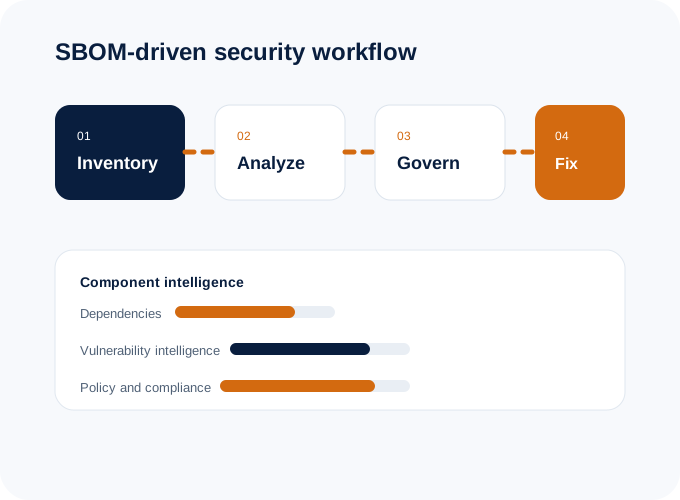
A practical lifecycle for discovering and reducing dependency risk.
Discover
Inventory open source packages, versions, direct dependencies and transitive dependencies.
Assess
Correlate components with vulnerabilities, licenses, policies and relevant risk context.
Prioritize
Focus teams on material risk using severity, exposure, exploitability and application context.
Remediate & Monitor
Upgrade or replace risky components, verify the fix and continue monitoring after release.
Common Open Source Security Risks
Known Vulnerable Dependencies
Applications can inherit publicly disclosed vulnerabilities through packages and transitive dependencies.
Outdated Components
Old package versions may increase maintenance and security exposure when supported fixes are available.
Malicious Packages
Compromised or intentionally malicious packages can introduce supply chain risk before code reaches production.
License Conflicts
Unapproved or incompatible licenses can create legal and distribution concerns for software products.
Dependency Confusion
Package naming and repository resolution issues can expose development pipelines to unintended components.
Untracked Software Components
Incomplete inventories make it harder to determine affected applications when a new vulnerability is disclosed.
Integrate Open Source Security Into CI/CD
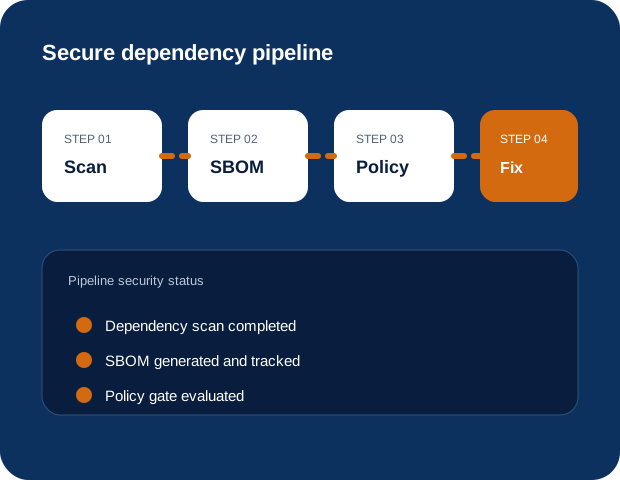
Security checks can be introduced at commit, pull request, build and release stages so dependency risk is identified earlier. Automation can also generate SBOMs, enforce policies and route findings into existing developer workflows.
Developer Workflow
Surface dependency issues close to where changes are made.
Pipeline Gates
Apply policy checks before artifacts progress through delivery stages.
Release Visibility
Maintain component and SBOM context for released software.
Continuous Response
Reassess exposure when new dependency vulnerabilities emerge.
Open Source Security Management Tools in India
Indian enterprises building digital products across BFSI, healthcare, automotive, retail, manufacturing and IT services increasingly need visibility into third-party software used across applications and delivery pipelines.
A practical enterprise program should connect development, application security, infrastructure, procurement and legal stakeholders around common component inventories, policies and remediation workflows.
Discuss Your Open Source Security Requirements
How to Choose Open Source Security Management Tools
Evaluate capabilities against your application portfolio, development model, risk appetite and compliance requirements.
1. Dependency Coverage
Check support for the programming languages, package managers, repositories and artifact formats used by your teams.
2. Vulnerability Intelligence
Review vulnerability data sources, update frequency, severity context and prioritization capabilities.
3. SBOM Support
Check SBOM generation, ingestion, export, version tracking and downstream analysis requirements.
4. License Compliance
Evaluate license identification, policy controls, reporting and review workflows.
5. Developer Integration
Look for IDE, pull request, repository, CI/CD, ticketing and API integrations that fit your engineering process.
6. Prioritization
Assess whether the platform can reduce noise using reachability, exploitability, exposure or application context.
7. Governance
Consider policy enforcement, exceptions, audit trails, roles and centralized reporting for enterprise teams.
8. Remediation
Evaluate upgrade recommendations, automated fixes, workflow integrations and verification of remediation.
Open Source Security Topics We Cover
Open Source Security Management Solutions from Meteonic
Meteonic helps organizations evaluate and deploy enterprise open source security technologies across software composition analysis, dependency security, SBOM, license compliance and software supply chain risk management.
With 18+ years of experience and 300+ unique clients including Fortune 500 organizations, Meteonic supports security, engineering and DevSecOps teams with enterprise-focused cybersecurity solutions.
Ask for a Free DemoQuestions Security and Engineering Leaders Ask About Open Source Security
What are open source security management tools?
They are tools that help organizations discover, assess, govern and monitor open source and third-party software components, often through SCA, dependency scanning, SBOM and license compliance capabilities.
What is software composition analysis?
Software Composition Analysis, or SCA, analyzes open source and third-party components used by an application to identify security, licensing and dependency risks.
What is an open source vulnerability scanner?
An open source vulnerability scanner identifies known security issues in software dependencies and components using vulnerability intelligence and component identification techniques.
What is SBOM management?
SBOM management is the process of creating, collecting, maintaining and analyzing software component inventories to improve software supply chain visibility and vulnerability response.
Why is dependency scanning important?
Dependency scanning helps teams identify vulnerable, outdated or policy-restricted packages before and after software is released.
Can SCA tools integrate with CI/CD?
Yes. Many SCA platforms provide CI/CD integrations or APIs so dependency checks and policy controls can become part of automated software delivery workflows.
What is software supply chain security?
Software supply chain security protects the software components, dependencies, build processes and delivery systems involved in creating and distributing applications.
How can enterprises manage open source license compliance?
Organizations can inventory component licenses, define acceptable-use policies, identify exceptions and route findings to legal, procurement and engineering stakeholders.
Reduce Open Source and Software Supply Chain Risk
Get expert guidance on SCA, dependency security, SBOM management and open source governance for your enterprise.
Request a Free DemoTalk to a Security Expert